
ODDWAVE

REAL ASTRONOMY WORLD HUB // SATURN II

What does Enceladus
sound like?

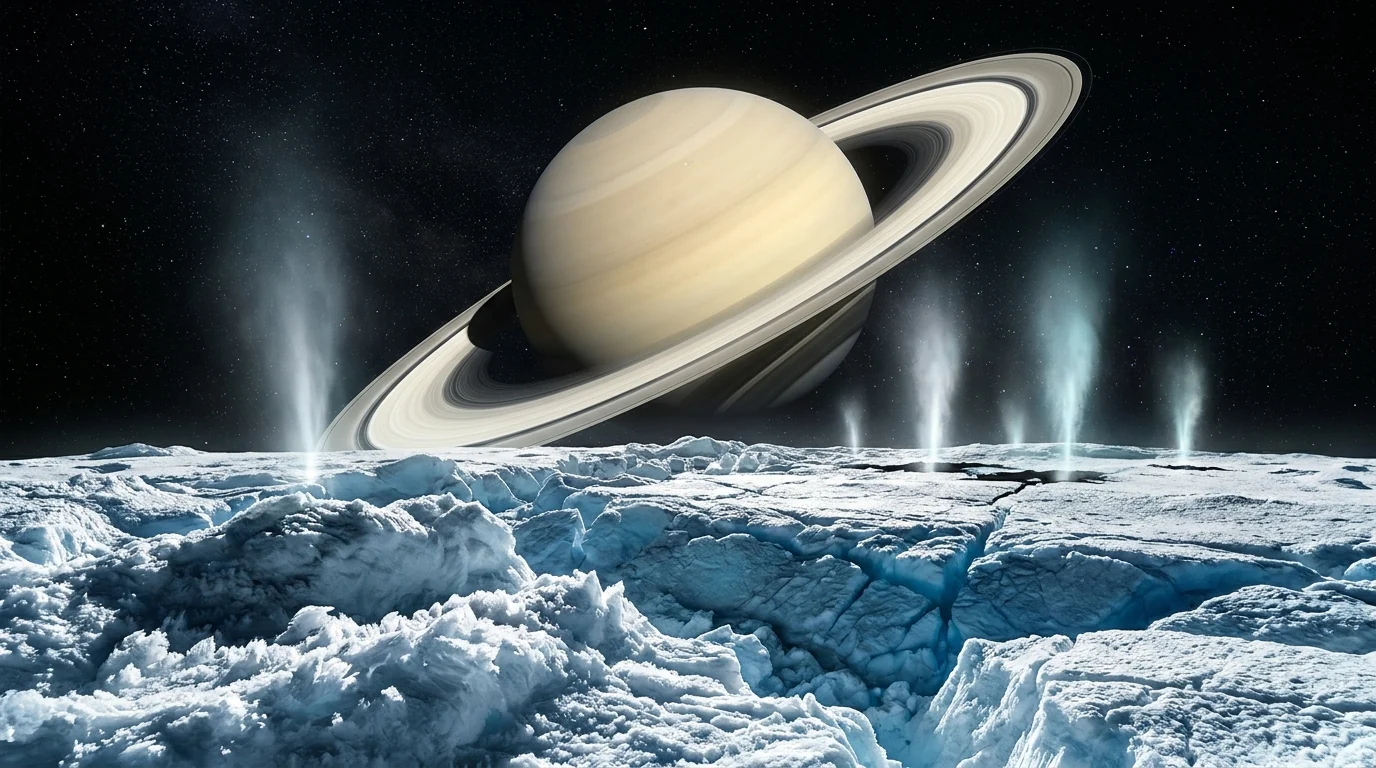
Reflecting 99% of incoming sunlight, Saturn’s brightest icy moon conceals a global saltwater ocean beneath its −198 °C crust—erupting supersonic cryo-geysers straight into Saturn’s E ring.

DISTANCE 1.4B KM GRAVITY 0.113 m/s² TEMP −198 °C ALBEDO 0.99 (BRIGHTEST IN SOLAR SYSTEM)

NASA CASSINI MISSION SCIENCE

Tiger-stripe cryo-geysers,
microgravity & plasma dust.

With almost no atmosphere, sound cannot travel through air on Enceladus—yet NASA’s Cassini spacecraft recorded thousands of microscopic ice-grain impacts and plasma waves as it flew directly through the plumes.

01 // SOUTH-POLAR TIGER STRIPE GEYSERS

Supersonic Ocean Plumes at 0.113 m/s²

Tidal flexing from Saturn’s gravity heats Enceladus’s rocky core, sustaining a warm global ocean beneath miles of fresh water ice (albedo 0.99). Four parallel south-polar fissures—the “tiger stripes”—vent water vapor, ice grains, and complex organic molecules at ~1,300 km/h.

Because surface gravity is just 0.113 m/s² (~1.1% of Earth’s), much of this icy spray escapes into orbit, continuously replenishing Saturn’s translucent blue E ring.

02 // CASSINI RPWS PLUME & E-RING AUDIO

Ice-Grain Impacts & Plasma Waves

When Cassini plunged through Enceladus’s south-polar plume, its Radio and Plasma Wave Science (RPWS) antennas registered dense bursts of electrically charged ice-dust impacts and plasma-wave sweeps linking Enceladus directly to Saturn’s aurora.

UPDATED ON: 2026-11-26 // PUBLIC-DOMAIN MISSION DATA

EPISODE 02 // ENCELADUS · LIVE NOW

Watch Episode 02 live
— or land on Enceladus now.

Episode 02 weaves real Cassini E-ring and plume plasma recordings beneath 45 minutes of crystalline cosmic ambient. Listen below, then fly the south-polar descent yourself in Enceladus Lander.